
Hong Kong Stocks Retreat as Tech Selloff Deepens: Sector Rotation Signals a More Selective Market
Keywords: Hong Kong stocks, Hang Seng Index, Hang Seng Tech Index, sector rotation, technology selloff, storage chips, AI stocks, PCB, banks, healthcare, technical bear market
Introduction
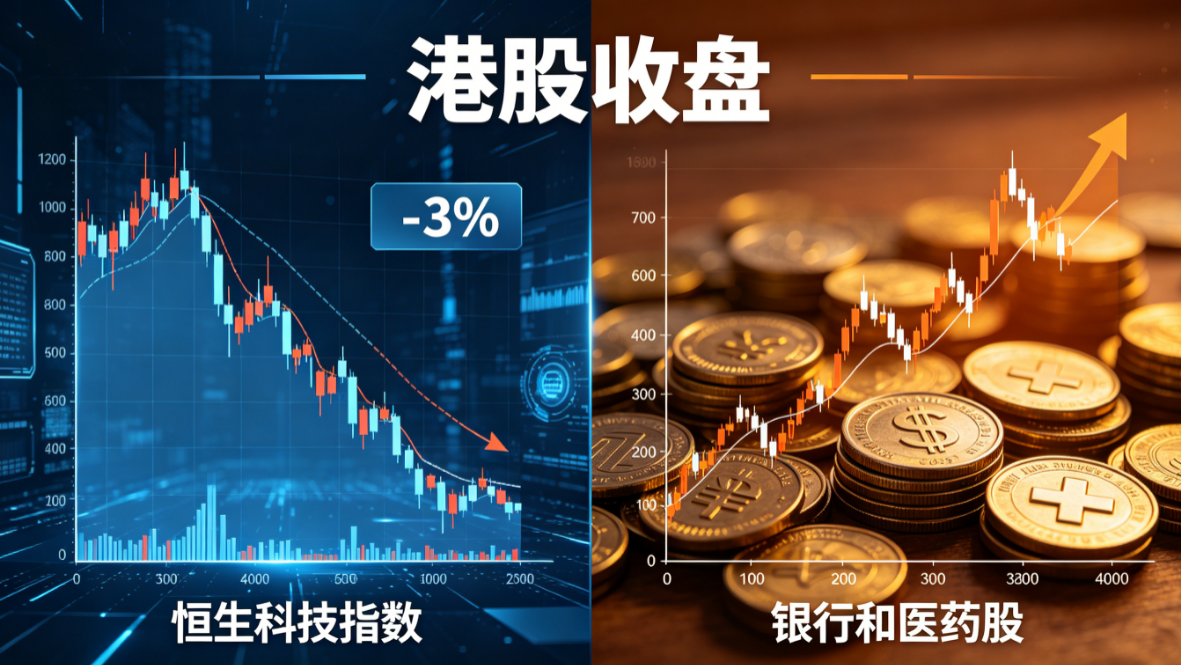
Hong Kong equities opened the session under pressure and never recovered, with all three major benchmarks finishing sharply lower. The Hang Seng Index fell 1.82% to 23,336.28, the Hang Seng China Enterprises Index lost 1.96% to 7,759.36, and the Hang Seng Tech Index slumped 3.30% to 4,399.22. The scale of the decline in technology shares was particularly striking: after today’s drop, the Hang Seng Tech Index has retreated more than 20% from its year-to-date high, while the H-share index has also fallen over 20% from its October peak, pushing both into technical bear market territory.
The broader message from today’s market was not simply “risk-off,” but a clearer and more meaningful rotation. Funds moved away from high-beta, momentum-driven technology names and into more defensive sectors such as banks and selected healthcare stocks. In other words, the market is no longer rewarding broad thematic enthusiasm; instead, it is increasingly discriminating between sectors, business models, and valuation support.
Technology Stocks Lead the Decline
Storage chips: overseas weakness spills over to Hong Kong
The most visible pressure point came from the semiconductor and storage chip space. Shares such as Alchip Technologies-style peers and mainland-listed chip names trading in Hong Kong, including JCET-related beneficiaries and memory names like GigaDevice and Montage Technology, were heavily sold. Montage Technology fell 12.44%, while GigaDevice dropped 10.30%.
The immediate catalyst was not isolated to Hong Kong. Regional markets across Asia also weakened, with South Korea’s Kospi falling sharply at one point, and leading memory players SK Hynix and Samsung Electronics facing visible selling pressure. This matters because the current cycle in storage chips is highly global in nature. Memory pricing, inventory expectations, and AI-related demand all feed into a tightly linked international supply chain. When the Korean market signals caution, Hong Kong’s chip proxies are rarely insulated.
From a technical perspective, this type of cross-market correlation typically amplifies downside volatility. Hong Kong’s technology names do not trade only on local fundamentals; they frequently reprice in response to changes in U.S. semiconductor sentiment, global memory price expectations, and risk appetite in Asia. That makes the sector vulnerable when momentum fades, even if the medium-term industry trend remains intact.
AI stocks see profit-taking and short interest rise
Artificial intelligence remained one of the most crowded trades in the Hong Kong market this year, but today it was also one of the most vulnerable. MiniMax-W fell 16.46%, Cloudwise dropped 14.35%, and Zhipu declined 9.96%.
This weakness looks more like a classic “high-conviction trade unwind” than a fundamental collapse. The AI sector had enjoyed a strong run, but that rally created a natural setup for profit-taking. More importantly, short sellers appear to be becoming increasingly active at higher price levels. In Zhipu’s case, the number of shorted shares surged sharply in the previous session, and the short-selling amount reached a multi-month high. That suggests market participants are not merely fading the trade intraday; they are actively positioning against near-term exuberance.
Another important factor is the upcoming lock-up expiration pressure. MiniMax and Zhipu are approaching their first major post-IPO test, with a concentrated release of cornerstone and restricted shares from July’s listing. In markets where supply is limited and narrative premium is high, even the expectation of future float expansion can trigger de-rating before the actual unlock occurs. This is particularly true for pre-profitability growth names whose valuations depend heavily on long-duration revenue assumptions.
PCB names dragged down by the broader tech unwind
Printed circuit board stocks also came under pressure, reflecting the market’s broader de-risking within the technology complex. Winners from the AI hardware and electronics manufacturing cycle, such as Shing Ho Technology, KB Components-style peers, and Broadex-related names, saw notable declines.
This is an important reminder that sectors such as PCB are often treated by investors as “secondary beneficiaries” of the AI and electronics cycle. When the primary theme weakens, these adjacent beneficiaries can see sharper volatility because their valuation support is less direct. In short, if the market questions the durability of the AI hardware capex cycle, the selloff is rarely confined to one node in the value chain.
Defensive Rotation Gains Traction
Banks attract yield-seeking capital
While technology suffered, banks moved in the opposite direction. Bohai Bank rose 2.86%, Jiujiang Bank gained 2.22%, and Industrial and Commercial Bank of China advanced 1.16%.
The relative strength of banks is consistent with a broader portfolio rebalancing story. As growth-sensitive sectors lose momentum, capital often rotates into high-dividend financials that offer lower volatility and clearer cash-return visibility. In Hong Kong, where dividend yield remains a critical allocation metric for many institutions and income-oriented investors, banks become more attractive when market breadth narrows.
Brokerage commentary has increasingly pointed out that bank stocks had been underrepresented in investor portfolios during the technology-led rally. If market style begins to normalize, high-dividend defensive sectors could see incremental inflows simply because they provide a more predictable total-return profile. In a market environment where earnings visibility matters more than story momentum, that matters a great deal.
Healthcare benefits from policy and efficiency improvements
Healthcare stocks also showed relative resilience, with Kintor Pharmaceutical-B gaining 7.31% and Fudan Zhangjiang rising 5.15%. Jing Tai Holdings also advanced 5.05%.
The driver here is not purely sentiment. China’s latest drug registration report pointed to a notable improvement in clinical trial efficiency. According to the report, the total number of registered drug clinical trials in 2025 exceeded 5,000 for the first time, reaching 5,215, a record high. New drug trials accounted for 2,997 cases, up 18% year on year, while bioequivalence trials reached 2,218 cases.
More importantly, the report highlighted faster development timelines. The average time required for domestic new drug trials to obtain the first informed consent from a subject fell to 6.8 months, down four months from 2024. The share of trials obtaining first informed consent within six months rose to 74.2%, with chemical drugs and biologics performing especially well.
This matters because in biotech and pharma, time is capital. Faster trial initiation reduces financing pressure, improves R&D efficiency, and shortens the gap between pipeline creation and value realization. For listed companies, a more efficient regulatory process can translate into a higher probability of near-term catalysts, which explains why some healthcare names outperformed despite the broader market weakness.
Individual Stocks: Supply Shock and Earnings Pressure
China Tobacco Hong Kong drops on weaker guidance expectations
China Tobacco Hong Kong fell 4.24% to HK$19.63. The move reflects the market’s continued sensitivity to companies facing earnings pressure or a deterioration in top-line expectations. The company is expected to report an approximate 25% to 30% decline in first-half revenue, which naturally raises questions about demand resilience and margin stability.
In a weak macro tape, stocks with visible earnings downgrades are usually punished disproportionately. Investors tend to shorten their time horizon and apply higher discounts to businesses where revenue visibility is falling, especially if the stock had previously been viewed as a quasi-defensive holding.
Yaotai Kang’an’s plunge reflects classic unlocking risk
The most dramatic move of the day came from Yaotai Kang’an, which collapsed 59.71% to HK$11.25. The reason was straightforward: a massive share unlock involving 119 million shares.
This is a textbook example of liquidity pressure overwhelming valuation. When a stock with limited free float faces a large unlock, the market often reprices immediately to account for potential supply overhang. In such cases, the drop is not necessarily a verdict on business quality; rather, it reflects the mechanical interaction between supply expansion and limited near-term buying interest.
From a trading perspective, unlock events are among the most important risk factors in Hong Kong’s small- and mid-cap universe. They can overwhelm otherwise positive fundamentals if the market perceives that insiders or early investors may seek to monetize gains quickly. That is why post-IPO and post-unlock analysis is essential in this market.
What Today’s Action Really Means
The key lesson from today’s trading is that Hong Kong is entering a more selective phase. The market is still willing to bid up sectors with clear policy support, defensible earnings, or stable dividend yields, but it is far less forgiving toward richly valued, momentum-driven technology names. The result is a sharper style divide: growth is being repriced, defensives are regaining relevance, and liquidity is becoming more selective.
Technically, the fact that both the Hang Seng Tech Index and the H-share index have fallen more than 20% from recent highs is not merely symbolic. It indicates that the market has transitioned from a correction into a deeper de-risking phase. That tends to change investor behavior. Instead of chasing thematic upside, traders begin to focus on balance sheet strength, capital return, earnings durability, and event risk such as unlocks or regulatory updates.
The near-term outlook will likely hinge on whether tech sector earnings can reset expectations fast enough to restore confidence. If AI adoption, chip pricing, or earnings guidance improve meaningfully, some of today’s selloff could be absorbed. But if global tech sentiment remains weak and supply overhang continues to build around high-profile IPO names, the pressure on growth stocks may persist.
Conclusion
Today’s Hong Kong market was not simply a broad decline; it was a clear statement about changing investor preference. Technology, AI, and chip names that previously drove the rally are now facing profit-taking, short selling, and valuation compression. At the same time, banks and healthcare stocks are attracting capital as investors seek stability, yield, and policy-backed visibility.
This type of rotation often marks an important turning point. It suggests that the market is moving away from narrative-led trading and toward a more fundamentals-driven regime. For investors, the implications are clear: stock selection matters more than ever, and risk management around unlocks, valuation, and cross-market sentiment is becoming central to performance. In a market that has entered technical bear territory in key indices, discipline may now be the most valuable asset.