

The Fed’s Hawkish Turn and the Market’s Mispricing Debate: Why Wall Street Is Split on the Next Rate Move
Keywords: Federal Reserve, interest rates, inflation, monetary policy, PCE, Treasury yields, hawkish pivot, Wall Street forecasts, bond strategy, macro risk
Introduction
Since the Federal Reserve’s latest policy meeting, expectations for a renewed tightening cycle have intensified, reshaping market pricing across rates, bonds, and currencies. The central bank left its benchmark rate unchanged, but nearly half of policymakers signaled that they expect at least one rate hike this year. For investors, that message was enough to trigger a swift repricing of risk.
Yet beneath the market’s increasingly hawkish narrative lies a significant split on Wall Street. While some major banks now see multiple hikes ahead, others argue that investors are overestimating the Fed’s willingness—and ability—to tighten again. The disagreement is not merely about timing. It reflects deeper uncertainty about the persistence of inflation, the transmission of policy through financial conditions, and whether the Fed is entering a true policy pivot or simply delivering a more forceful communication strategy.
The Fed’s Message: Unchanged Rates, Changed Tone
The Fed did not raise rates at its latest meeting, but the decision was anything but dovish. The updated “dot plot” showed a clear shift toward a more restrictive stance, with roughly half of officials projecting at least one additional hike before year-end. In practice, that means policymakers are no longer treating inflation as a problem that can be solved by patience alone.
This matters because the central bank’s forward guidance often shapes market expectations more powerfully than the policy rate itself. When the Fed signals that the next move could be up, investors quickly adjust discount rates, yields, and portfolio positioning. That is exactly what happened: two-year Treasury yields moved higher, and derivatives markets began pricing in the possibility of a rate increase as soon as the October meeting.
The hawkish tone was reinforced by the Fed chair’s remarks that inflation has remained above target for five consecutive years. That framing is critical. It suggests the central bank is no longer viewing inflation as a temporary post-pandemic distortion, but as a more entrenched macroeconomic challenge. Once inflation becomes a durability problem rather than a volatility problem, the policy bias tends to shift toward restraint.
Why Markets Reacted So Quickly
The bond market was the first to respond, and for good reason. Front-end yields are most sensitive to changes in the expected path of policy rates. If investors believe the Fed is more likely to hike, the repricing will show up first in the two-year sector, which serves as the market’s best proxy for short-term policy expectations.
But the move was not simply about the dot plot. Investors also absorbed a broader set of signals:
- The removal of dovish language from the statement suggested a less flexible Fed.
- Higher inflation readings have reduced confidence that price pressures are already on a clean downward path.
- Energy risks remain elevated, which complicates the inflation outlook.
- The labor market has not weakened enough to force the Fed into an immediate easing bias.
Put differently, the market is beginning to ask whether the Fed’s current stance is still sufficiently restrictive in real terms. If inflation proves sticky while growth remains resilient, policymakers may decide that one more hike is justified to re-anchor expectations.
Wall Street Is Not Unified: A Split in Forecasts
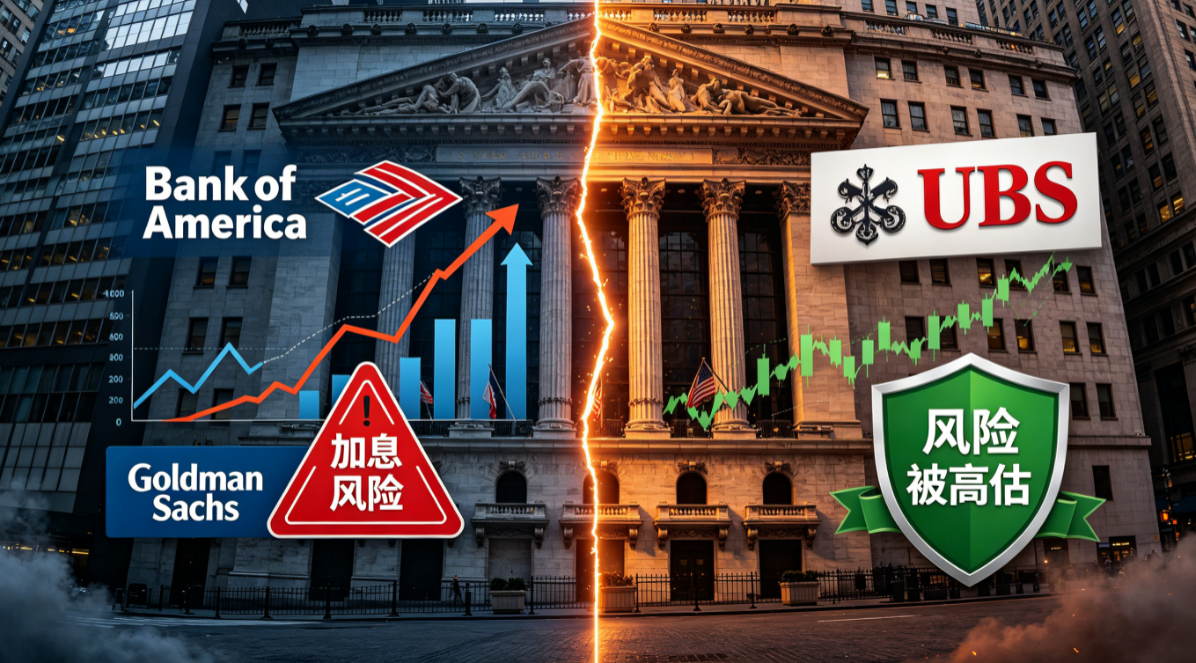
The latest forecasts from major banks highlight how uncertain the outlook has become. Bank of America recently became the most aggressive among large global institutions, projecting three rate hikes this year on the view that inflation has “clearly deteriorated.” Deutsche Bank expects two hikes. These forecasts imply that the Fed may need to do more than maintain restrictive settings—it may need to actively re-tighten.
Other institutions, however, are pushing back.
UBS argues that the market is overstating the probability of further tightening. Its base case is that the Fed will hold rates steady through the rest of the year and only restart easing in early 2027. That is a notably different framework. It assumes that current policy is restrictive enough to keep inflation in check without requiring additional hikes, and that rate cuts remain a much more distant story.
Citi is also on the easing side of the debate, forecasting cuts in October and December 2026, followed by another reduction in January 2027. This underscores an important point: even among institutions that agree inflation remains above target, there is no consensus on whether the next policy move must be a hike, a hold, or simply a long pause.
UBS’s Core Argument: The Market May Be Overpricing Tightening
UBS’s position rests on several technical assumptions that deserve attention. First, it believes the market is extrapolating the most hawkish rhetoric too literally. Central banks often use tougher language to preserve credibility without necessarily committing to a sequence of hikes. In that sense, hawkish communication can serve as a substitute for action.
Second, UBS sees the inflation risk as contingent rather than structural. If the geopolitical and supply-side shocks that have supported energy prices ease—especially if the Strait of Hormuz remains open and shipping flows normalize—then one of the key upward pressures on headline inflation could fade. That would reduce the need for the Fed to respond aggressively.
Third, the bank notes that some of the more hawkish forecasts appear to be driven by non-voting officials. This is an important institutional detail. In the Federal Reserve system, not every policymaker has equal decision-making power at every meeting. As a result, rhetorical hawkishness from regional presidents or staff economists may influence sentiment without necessarily determining policy.
Finally, UBS believes the Fed’s newly launched policy review process may create a bias toward caution. The chair’s announcement of five working groups—covering communication, balance sheet management, data sources, productivity and employment, and inflation assessment—signals that the institution is reassessing its framework. When a central bank is in review mode, it may be less willing to make abrupt policy changes before those conclusions are in place.
The PCE Report: The Next Critical Test
For all the debate around forecasts, the next major catalyst is the Personal Consumption Expenditures price index, particularly core PCE. This is the Fed’s preferred inflation gauge and arguably the single most important monthly data release for near-term policy expectations.
Why does PCE matter so much? Because it captures changes in consumer spending patterns and provides a more comprehensive view of inflation than headline CPI alone. If core PCE shows persistent momentum, the case for another hike strengthens considerably. If it decelerates meaningfully, the Fed can justify staying put without losing credibility.
Investors will focus on several components of the report:
- Core goods inflation, to see whether supply-chain normalization is continuing
- Core services inflation, especially shelter and labor-intensive categories
- Energy pass-through effects, which may distort the headline figure
- Sequential momentum, rather than just year-over-year comparisons
A soft PCE print could quickly unwind some of the recent hawkish repricing. A hot one could validate the most aggressive forecasts and push Treasury yields even higher.
What This Means for Bonds and Portfolio Strategy
UBS’s recommendation to favor high-quality short- and intermediate-duration bonds reflects a classic defensive response to a more uncertain policy environment. In a regime where rates may remain elevated for longer, duration risk becomes expensive. Shorter maturities provide yield without exposing investors to the full convexity risk of a further move up in yields.
This is especially relevant because the front end of the curve is highly sensitive to Fed expectations. If markets are pricing too much tightening, short-duration bonds can become attractive once the initial repricing is complete. Investors can lock in yields while avoiding the capital losses that would accompany a continued rise in policy expectations.
At the same time, a hawkish Fed does not automatically mean all bond exposures should be reduced. If the economy slows more sharply than expected or inflation surprises to the downside, duration can rally quickly. The key is to position around scenario asymmetry: the market is currently more exposed to the risk of being too dovish than too hawkish, but that balance can shift fast.
Conclusion
The latest Fed meeting has not just changed rate expectations; it has reopened the broader debate over the future of U.S. monetary policy. One camp sees an inflation problem that still requires additional tightening. Another believes the Fed is signaling toughness without intending to follow through with multiple hikes. Between those views lies a market that is trying to price uncertainty in real time.
The most important lesson is that policy communication and policy action are not always the same thing. The Fed’s hawkish tone has already moved yields and reshaped positioning, but the actual next step remains contingent on incoming data, especially core PCE and subsequent inflation trends. If price pressures persist, the case for a hike grows stronger. If they ease, the current hawkish repricing may prove excessive.
For investors, the right response is not to anchor on a single forecast, but to prepare for volatility around the inflation path. In this environment, disciplined duration management, sensitivity to data releases, and a clear understanding of Fed reaction function are more valuable than any one headline prediction.